 Input by Daniela Truffer / Zwischengeschlecht.org, Rainbow Cities Network NGO meeting

 Today is the Annual Day of the Rights of the Child, marking the adoption of the Convention on the Rights of the Child on 20 November 1989, for intersex people a most important human rights framework.
As a survivor of Intersex Genital Mutilations, I am particularly grateful to be able to speak here today.
I was born in 1965 with abdominal testes and so called “ambiguous” genitalia.
At two months they removed my healthy testes and threw them in the garbage bin. At seven they cut my genital to make me look more like a girl, allegedly with my consent. At 12 I was prescribed estrogens to induce an artificial puberty, which I still have to take daily.
Today they would probably make a boy out of me, with even more surgeries, complications, and pain.
The doctors always lied to me and my parents. Only at 35 I discovered that I am not alone. Today I am fighting to prevent future intersex children from suffering like myself and my peers.

One of the most frustrating experience in my work is, how nowadays everybody seems to be caring for or at least talking about intersex, but hardly ever about IGM practices, let alone how to eliminate them.
I have to admit I was really irked by the Swiss Government’s press release for the Focal Points Roundtable, where they boast how Switzerland would be, I quote, «expressly extending protection to intersex persons» – that is, as long as it’s limited to, I quote, «discriminations based on sexual orientation or gender identity» – for most intersex people basically a non-problem.
On the other hand, regarding the undisputed intersex problem number one, IGM practices, Switzerland simply denies them, while in fact funding and protecting the perpetrators, not the victims – just like any other so called “developed nation”.
Currently, the UN Committee against Torture questioned Austria, Denmark and China over IGM. All countries flat-out denied the well-documented ongoing practice, while at the same time invoking «leadership in LGBTI issues».

One last example, the current “Intersex Focus Paper” by the EU Agency for Fundamental Rights, which simply fails to identify ANY relevant human rights frameworks or UN documents.
While the paper goes on and on about identity, gender and birth certificates – it NOT ONCE mentions harmful practices, inhuman treatment, legislation to end IGM, access to redress and justice, statutes of limitations, monitoring, or other crucial items for advancing intersex rights.
Tellingly, the FRA’s only legal recommendation concerns birth certificates and identity documents – while regarding IGM, they seriously propose having nice chats with the mutilators and their accomplices.
Frankly, with supporters like these, who needs enemies?
So, I would like you to consider for a moment:
Are you and your agency able to adequately address IGM practices, including as harmful practice and inhuman treatment – or are you only fit to address discrimination and identity?
In the first case, I would like to win you as a vital intersex ally.
In the second, I ask you to at least do better than the Swiss Government, falsely claiming to «expressly protect intersex persons».
Thank you.
>>> Intersex Flyer distributed @ Rainbow Cities + LGBTI Focal Points (PDF 118kb)
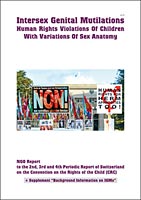
Intersex Genital Mutilations • 17 Most Common Forms
Human Rights Violations Of Children With Variations Of Sex Anatomy
IGM – Historical Overview • What is Intersex? • How Common are IGMs?
>>> Download PDF (3.65 MB) >>> Table of Contents
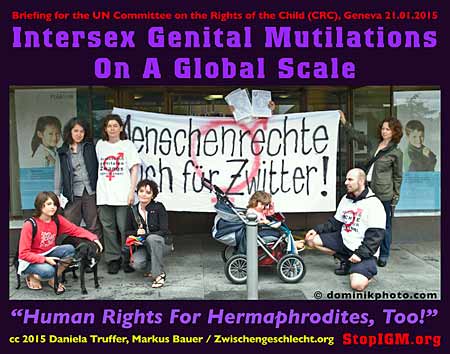 IGM as a Harmful Practice: 2015 UN-CRC Briefing
• IGM: A Survivor’s Perspective • Intersex Movement History
• What are Variations of Sex Anatomy? • What are IGM Practices?
• IGM and Human Rights • Conclusion: IGM as a Harmful Practice
>>> Download PDF (3.14 MB) >>> Table of Contents
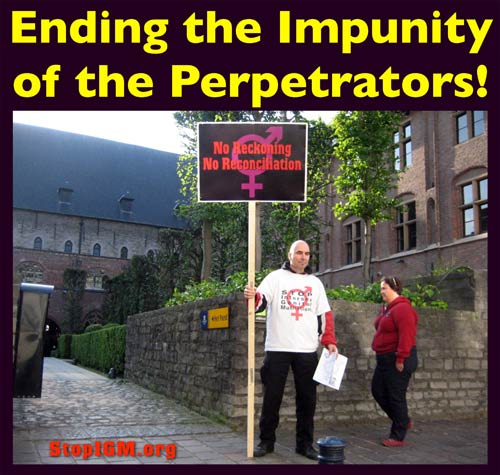
Exploring the the possibilities of eliminating IGM practices by making the perpetrators accountable via well-established applicable human rights frameworks, including Inhuman Treatment and Harmful Practices @ the UN expert meeting on Intersex Human Rights in Geneva 26.–27.10.2015
>>> PDF (831kb)
(Photo: Intersex Protests vs. 1st D$Dnet Training School’ @ Ghent University Conference Centre ‘Het Pand’, 10.06.2015)
 Bearing witness to IGM during the 56th Session of the UN Committee against Torture:


 Tue 12:55h Committee member
 Wed 16:10h: A Delegate from the Hong Kong Justice Department (?) gave a global answer on “LGBTI” – without addressing Intersex at all:
 Wed 17:39h Sapana Pradhan-Malla mentions non-answer, repeats question on IGM practices, asks for statistics:
 Wed 17:47h A Hong Kong Delegate instead describes IGM as entirely unproblematic, purely medical issue:
 My 2 cents: The 3rd flat-out Gov denial of IGM practices in this session – and also the 3rd time in a row that Delegates tried to deflect from IGM by invoking “LGBTI” (or in the case of
 Ditte Dyreborg (Danish Intersex Advocate), Daniela Truffer, Markus Bauer (StopIGM.org),
 Mon 10:58h: Now
 Tue 15:58h: Intersex now on. Flat-out denial –
 Tue 16:58h: Country co-rapporteur Pradhan-Malla follows up on Intersex, highlighting CIDT. While hailing Denmark for leadership in LGBTI (or rather LGB or LGBT) rights, she continues:
 Alex Jürgen (VIMÖ), Daniela Truffer, Markus Bauer (StopIGM.org)
 So we were very pleased when during the following two-day session Chairperson Claudio Grossman, one of the Committee’s two country rapporteurs for Austria, on Thursday 12 November asked the Sate Delegation about IGM practices, if the state was aware of this violation? Are there any legislative measures in place? What could be done to prevent it? And when the next day Austria replied only dismissively, Grossman digged deeper in a second round of questions.
 In contrast, Austria’s answers delivered by Hon. Prof. Dr. Gerhard Aigner (Federal Ministry of Health) on Friday 13 November were not only a disgrace, but once again underlined how IGM practices are still only an “emerging” human rights issue, of which Governments still seem to think, if they ignore it long enough, it will disappear just as well.


 (See case file on p. 15 of NGO report)